§ 7 — Operations
Operations
How manned pilots talk, how airports work, what to do when a flight goes wrong, and how people and machines fail.
Most of this test can be learned as rules and numbers. Operations cannot, quite. It is where the FAA checks that you understand the world your aircraft flies in: how manned pilots talk, how an airport works, what to do when a flight goes wrong, how good pilots make bad decisions, how the body fails, and how to keep a machine fit to fly. It is the second-largest block of questions, about a quarter of the test, roughly 15 of the 60 you are scored on.
UAG Applicant Information Bulletin (PSI), eff. Sept. 29, 2025The breadth is why it is worth your time. A rule like 400 feet is checked in a second; a habit like noticing that you are the one who is tired has to be checked on every flight. The study guide estimates that about 80 percent of aviation accidents are related to human factors, with the largest shares on landing and takeoff, the two moments when an aircraft is closest to the ground.
FAA-G-8082-22, Ch. 10The chapter follows the FAA’s order: radio, airports, emergencies, decision making, physiology, maintenance, with a short closing part on night flying, which touches four of them. Sample questions are cited by number from the FAA’s published UAG sample set, and figures come from the test supplement, FAA-CT-8080-2H.
§ 7.1 — RADIO COMMUNICATIONS
Radio communications
Why you listen when you never talk
You need no radio, license, or aviation phrasing to fly under Part 107. The FAA says a remote pilot is not expected to communicate on aviation frequencies, and should not transmit on one except in an emergency.
FAA-G-8082-22, Ch. 7The test asks about radio anyway, for a practical reason. Under § 107.37 your aircraft yields to every other aircraft, and you cannot yield to something you do not know is there. Manned pilots near a small airport announce themselves before you could see or hear them, so a radio on the right frequency is a second set of ears on the airspace you are responsible for.
14 CFR § 107.37(a)Towered and non-towered airports
A towered airport has an operating control tower: controllers sequence arrivals and departures and pilots follow instructions. At a non-towered airport nobody runs the flow, and pilots separate themselves by looking and by talking on a shared frequency. Two-way radio is not required there, though monitoring it is good practice. Airports are civil and open to the public, military or other federal, or private, and the definition includes heliports and seaplane bases, which § 107.43 protects just as it protects a paved field.
FAA-G-8082-22, Ch. 11 · 14 CFR § 107.43Towers are not always staffed. On a sectional a star beside the tower frequency means part-time operation; when the tower is closed the airport is non-towered, so you need both sets of procedures for the same field. Towered airports and their data are printed in blue on the chart, other airports in magenta. For a remote pilot the tower is a source of information, not an instruction channel: the study guide recommends listening to the ATIS and then the tower or CTAF to know what traffic to expect.
FAA Chart Users' Guide, VFR Terms and Symbols · FAA-G-8082-22, Ch. 10CTAF, UNICOM, and MULTICOM
With no tower, aircraft need one agreed frequency to announce position and intentions: the Common Traffic Advisory Frequency, or CTAF. It can be a UNICOM, a MULTICOM, a flight service station frequency, or the tower’s own, and the chart and the Chart Supplement say which. UNICOM is a nongovernment air-to-ground station that may provide airport information where there is no tower or flight service station; the usual frequency is 122.8, but check rather than assume. Where there is no tower, no flight service station, and no UNICOM, the MULTICOM frequency 122.9 is used.
FAA-G-8082-22, Ch. 7| UNICOM at most non-towered airports | 122.8 MHz (check the chart) | FAA-G-8082-22, Ch. 7 |
|---|---|---|
| MULTICOM, where no tower, FSS, or UNICOM | 122.9 MHz | FAA-G-8082-22, Ch. 7 |
| Inbound self-announce, first call | about 10 miles out, with direction | FAA-G-8082-22, Ch. 7 |
| ATIS update | normally hourly, sooner if conditions change | FAA-G-8082-22, Ch. 11 |
The standard practice for an inbound manned aircraft is a first call about 10 miles out that includes its direction from the airport, followed by calls entering the pattern, on base, on final, and clear of the runway. Departing aircraft announce too.
FAA-G-8082-22, Ch. 7Reading frequencies on the chart
A small encircled C after a frequency marks it as the CTAF. A line reading AWOS or ASOS followed by a number is an automated weather broadcast, shown when a full-time ATIS is not available. A control tower frequency is labeled CT and printed in blue with its airport.
FAA Chart Users' Guide, VFR Terms and Symbols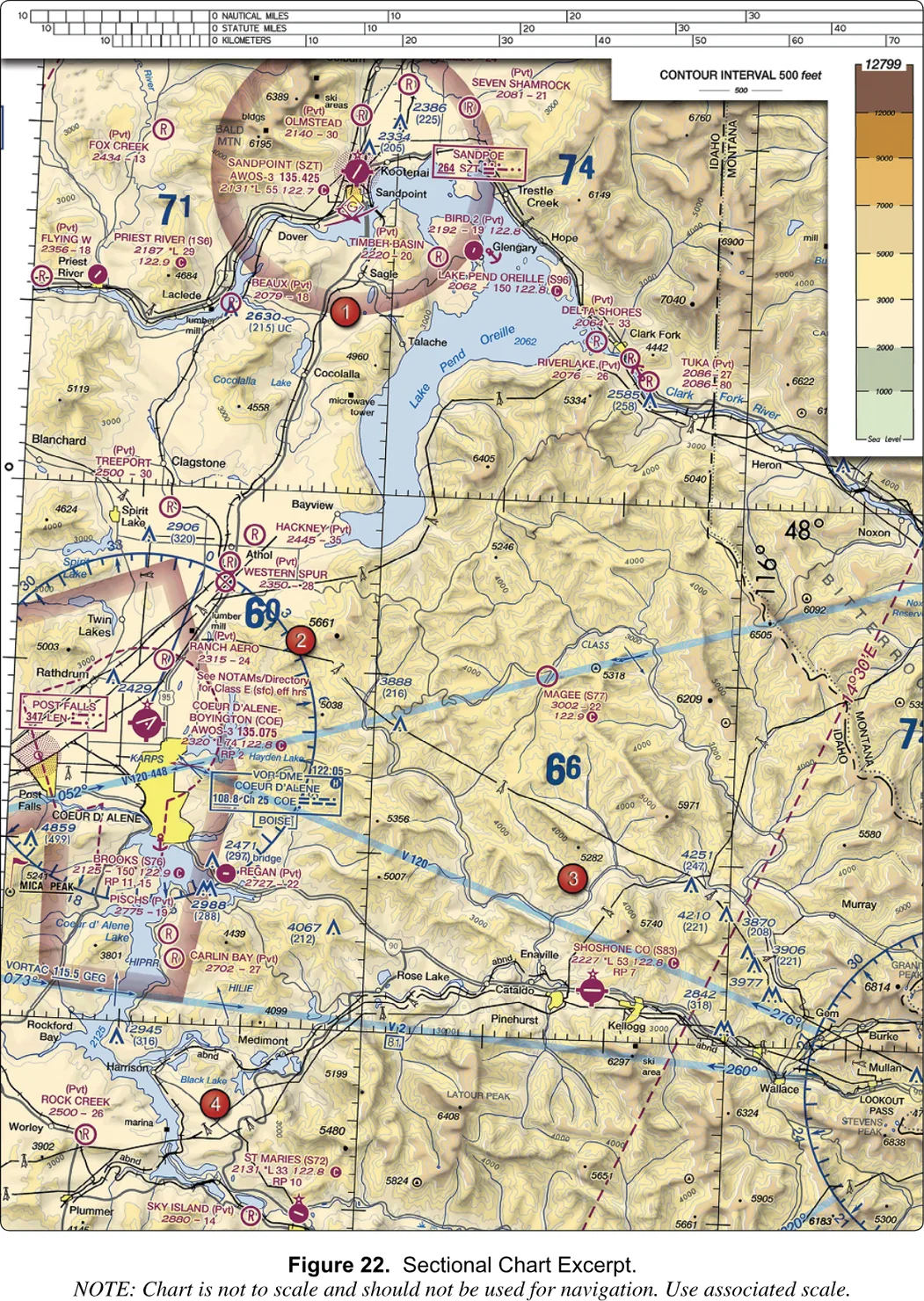
Figure 7-1 is the chart behind sample question 5. Beside Coeur d’Alene are two numbers that look alike and mean different things. The 135.075 follows AWOS-3, so it is the weather broadcast. The 122.8 followed by a C is the CTAF, which is what the question asks for. The remaining option, 122.05, is a flight service radio outlet that the Chart Supplement lists as Boise Radio.
FAA-CT-8080-2H, Fig. 22 and Fig. 31ATIS, AWOS, and ASOS
The Automated Terminal Information Service, ATIS, is a looped recording of local weather and other non-control information: runways in use, ATC procedures, construction. It is normally updated hourly, sooner when conditions change, and each version gets the next letter of the phonetic alphabet, Alpha, then Bravo, then Charlie. AWOS and ASOS are automated weather stations that produce the surface observations behind METARs and can broadcast them by radio; the chart shows their frequency where there is no full-time ATIS. Decoding the reports is covered in the weather chapter.
FAA-G-8082-22, Ch. 11 and Ch. 3a · FAA Chart Users' GuideCall signs, the phonetic alphabet, and numbers
Every U.S.-registered aircraft has a unique N number, and pilots spell it with the phonetic alphabet so it survives a noisy radio: N123AB is “November One-Two-Three-Alpha-Bravo.” On the air the N is usually replaced by the make for light aircraft (“Cessna One-Two-Three-Alpha-Bravo”), the model for heavier ones (“Citation One-Two-Three-Alpha-Bravo”), and airlines use the company name and flight number (“Southwest Seven-One-One”).
FAA-G-8082-22, Ch. 7| A to F | Alpha · Bravo · Charlie · Delta · Echo · Foxtrot | FAA-G-8082-22, Fig. 7-1 |
|---|---|---|
| G to L | Golf · Hotel · India · Juliett · Kilo · Lima | FAA-G-8082-22, Fig. 7-1 |
| M to R | Mike · November · Oscar · Papa · Quebec · Romeo | FAA-G-8082-22, Fig. 7-1 |
| S to X | Sierra · Tango · Uniform · Victor · Whiskey · X-ray | FAA-G-8082-22, Fig. 7-1 |
| Y and Z | Yankee · Zulu | FAA-G-8082-22, Fig. 7-1 |
| Digits as spoken | 0 zero · 1 wun · 2 too · 3 tree · 4 fower · 5 fife · 6 six · 7 seven · 8 ait · 9 niner | AIM, Ch. 4, Sec. 2 |
Phraseology: altitudes, directions, speed, and time
Direction from an airport is a compass point (“10 miles south”), and runways are said digit by digit. Times in aviation reports are UTC. Wind in a METAR or TAF is relative to true north, while headings and runway numbers are magnetic, which is why METAR questions keep asking “true or magnetic.” Speeds are in knots. Altitudes are said in thousands and hundreds of feet, so 1,500 is “one thousand five hundred,” and a manned pattern altitude is above sea level where yours is above ground level.
FAA-G-8082-22, Ch. 7 and Ch. 3a · AIM, Ch. 4, Sec. 2 · FAA-H-8083-25C, Ch. 13Runway numbers
A runway’s number is its magnetic heading with the last digit dropped. A runway pointing 130 degrees magnetic is runway 13, one pointing 270 is runway 27, and one pointing 090 is runway 9, painted 09. The far end points the opposite way, 180 degrees different, so runway 13 is also runway 31. Parallel runways add L, R, or C, from the point of view of a landing pilot. The airport diagram in Figure 7-4 shows 12/30 and the parallel pairs 17L/35R and 17R/35L, and the Chart Supplement entry in Figure 7-7 shows 5/23, which is 230 minus 50, or 180 degrees apart. Runway numbers are magnetic and chart north is true; the difference is magnetic variation.
AIM, Ch. 2, Sec. 3 · FAA Chart Users' Guide, Airport Diagrams · FAA-G-8082-22, Ch. 11Reading a position report
A manned pilot approaching a non-towered airport says the airport name first and last, so everyone on the frequency can confirm which field the call is for, then the call sign and position: “Cooperstown traffic, Cessna Four-Five-Tango-Kilo, midfield left downwind, runway one-three, Cooperstown traffic.” The study guide gives the whole sequence: inbound, entering the pattern, base, final, clear of the runway, and a matching departure call.
FAA-G-8082-22, Ch. 7Decode it a phrase at a time. “Midfield” means abeam the middle of the runway. “Left downwind” is the leg parallel to the runway, flown opposite to the landing direction, with every turn to the left. “Runway one-three” means landing toward a magnetic heading of about 130 degrees, which is southeast. So the aircraft is flying northwest alongside the runway, on the side that is to the left of the landing direction.
Sample question 18 asks where such an aircraft is relative to the runway (Figure 26, Cooperstown), with choices east, south, or west. Face the landing direction, southeast: your left hand points northeast, which is where a left-turn pattern lies. No choice says northeast, but only east is on that side. South and west are on the wrong side of the runway, and that is the only fact the question needs.
FAA-CT-8080-2H, Fig. 26 · UAG sample questions, Q18One thing the call does not say is height. A manned aircraft on downwind is near pattern altitude, about 1,000 feet above the airport, well above your 400-foot ceiling. The next part shows why that does not make the pattern safe to ignore.
§ 7.2 — AIRPORT OPERATIONS
Airport operations
The traffic pattern
Manned aircraft do not approach a runway from any direction at any height. They fly a rectangle with five named legs. Upwind continues straight out after takeoff. Crosswind is the first turn, ninety degrees. Downwind runs parallel to the runway in the opposite direction. Base turns back toward the runway, and final lines up with it. Unless the chart says otherwise all turns are to the left; a right-hand pattern is marked on the sectional with RP and the runway number, as in RP 23, with an asterisk when special conditions apply.
AIM, Ch. 4, Sec. 3 · FAA-G-8082-22, Ch. 11 · FAA Chart Users' GuideThe pattern is flown at about 1,000 feet above the airport, though it varies by airport. At a non-towered airport the preferred entry from the downwind side is a 45 degree approach to the downwind leg, joining at midfield.
FAA-G-8082-22, Ch. 11 · AIM, Ch. 4, Sec. 3Where a UA at 400 feet meets the pattern
On paper the numbers keep you apart: the pattern is near 1,000 feet and you are limited to 400. In practice they meet near the runway. A landing aircraft descends through your altitude on base and final, and a departing one climbs through it on upwind. The closer you are to the runway ends and the extended centerline, the more your airspace and theirs coincide.
The AC’s example is a small UA hovering 200 feet above a runway. It would not breach the right-of-way rule against an aircraft on downwind, but it could make that aircraft delay landing, or one holding short delay its takeoff. That is interference, and § 107.43 prohibits it. The AC’s working rule is to avoid the traffic pattern and published approach corridors, and, if you must work at an airport in uncontrolled airspace, to fly so that no manned pilot has to change course. In uncontrolled airspace no notification or authorization is needed, but you must still yield to everything, including aircraft on the surface.
14 CFR § 107.43 · AC 107-2A, para. 5.10.1, 5.10.1.1, 5.10.1.2Controlled airspace is a separate question. Class B, C, and D airspace, and the surface area of a Class E designated for an airport, need ATC authorization first under § 107.41. The FAA’s automated system for requesting it is LAANC, the Low Altitude Authorization and Notification Capability; the AC itself only points to the FAA’s UAS web pages for the current process, so the airspace chapter and the FAA site are where the procedure lives. For the pattern geometry with radio calls for each leg, work through the lesson on the traffic pattern and runways, and for what to do when a manned aircraft is actually approaching, right-of-way and see-and-avoid.
14 CFR § 107.41 · AC 107-2A, para. 5.10Runway markings and the airport diagram
Figure 7-4 is an airport diagram, a plan of the field for movement on the ground, with runways and their numbers, the parallel pairs told apart by L and R, the tower, the terminal, and the ramp. Diagrams are not intended for approach and landing.
FAA Chart Users' Guide, Terminal Procedures Publication · FAA-CT-8080-2H, Fig. 48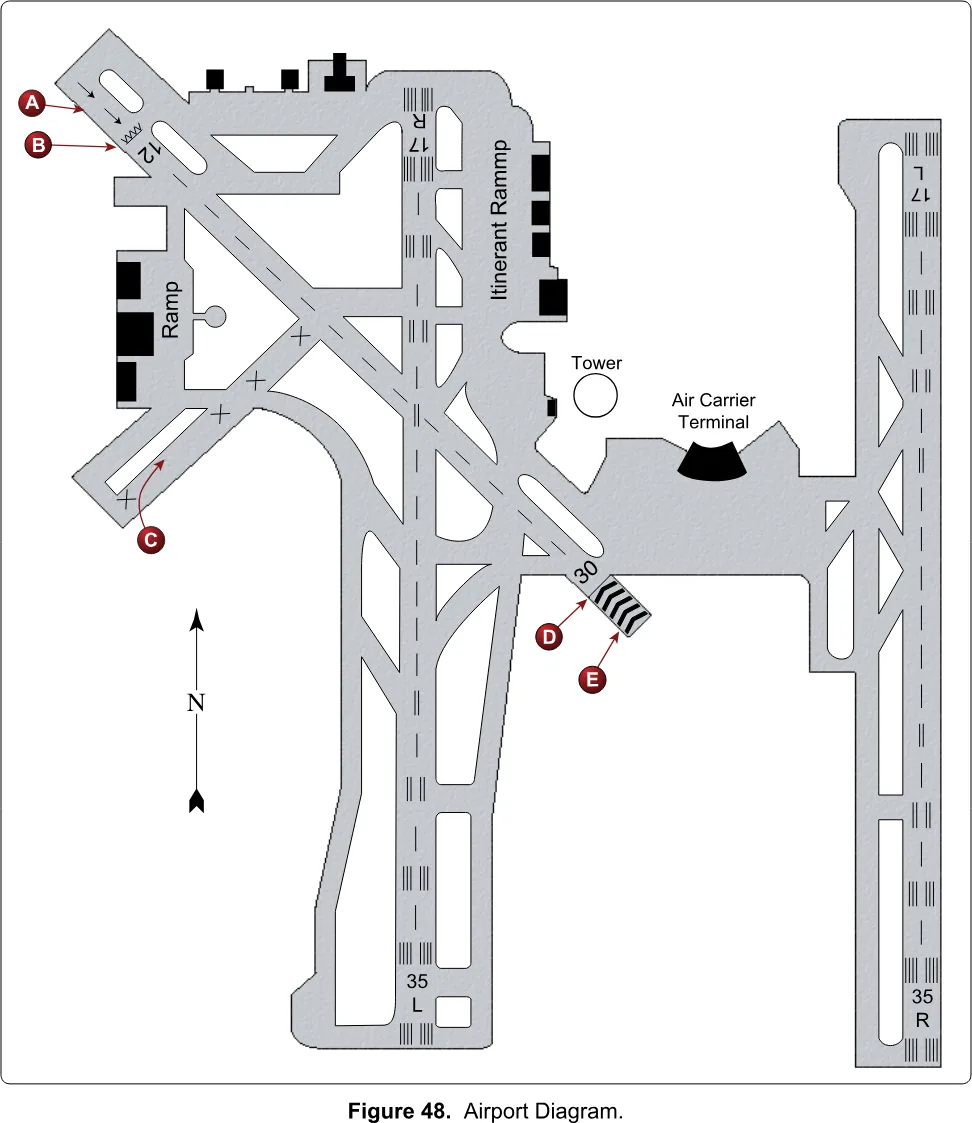
Three markings are worth knowing. Bars across the end of a runway mark the threshold, where the usable surface begins. Arrows ahead of a threshold mean it is displaced, so the pavement before it is not for landing. Crosses over a runway mean it is closed, as at area C, and chevrons, as at areas D and E, mark pavement that aircraft may not use for landing, takeoff, or taxiing, such as a stopway or blast pad. For a remote pilot the point is reading an unfamiliar runway from a distance: which end is which, whether it is closed, and where aircraft will be on the ground.
FAA Chart Users' Guide, Terminal Procedures Publication · AIM, Ch. 2, Sec. 3The segmented circle and wind indicators
Non-towered airports often show arriving pilots the active runway and pattern with a ground display: a wind indicator at the center of a segmented circle, with L-shaped traffic-pattern indicators outside it that show where the pattern differs from the standard left-hand one.
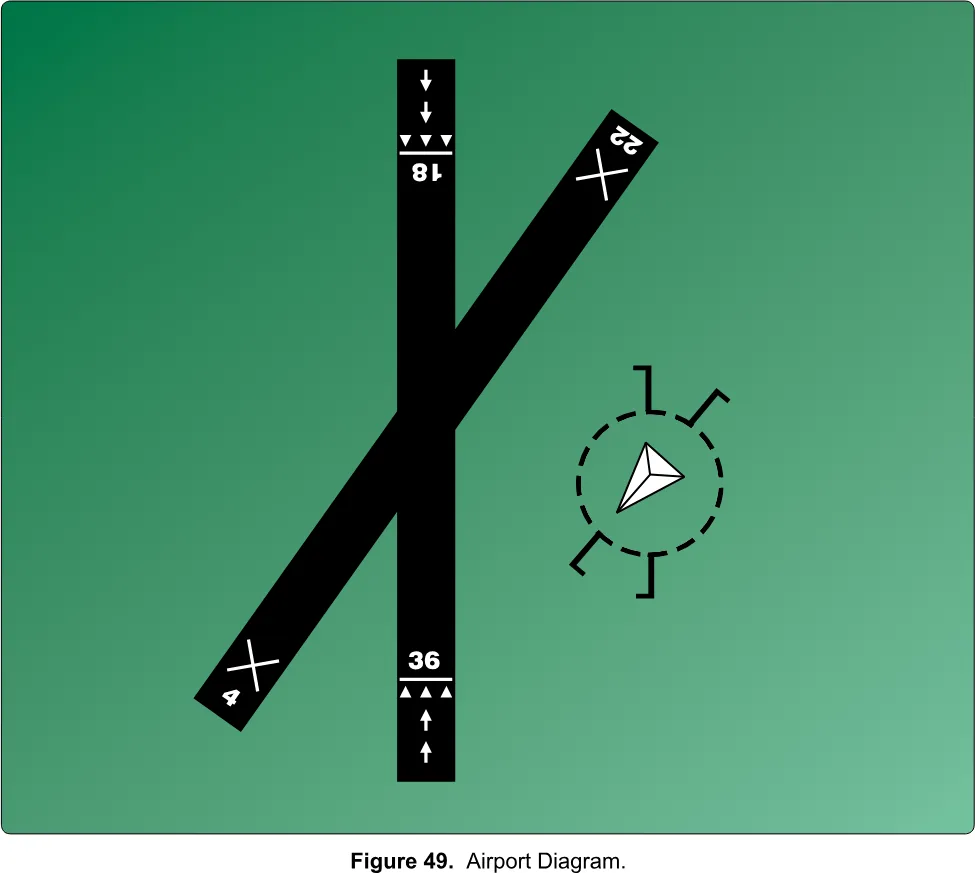
In Figure 7-5 the crossing runways are 18/36 and 4/22, the dashed ring with L-shaped brackets is the segmented circle, and the white shape at its center is a wind tetrahedron, an older wind and landing-direction indicator that pivots freely like a weather vane.
FAA-CT-8080-2H, Fig. 49 · AIM, Ch. 4, Sec. 3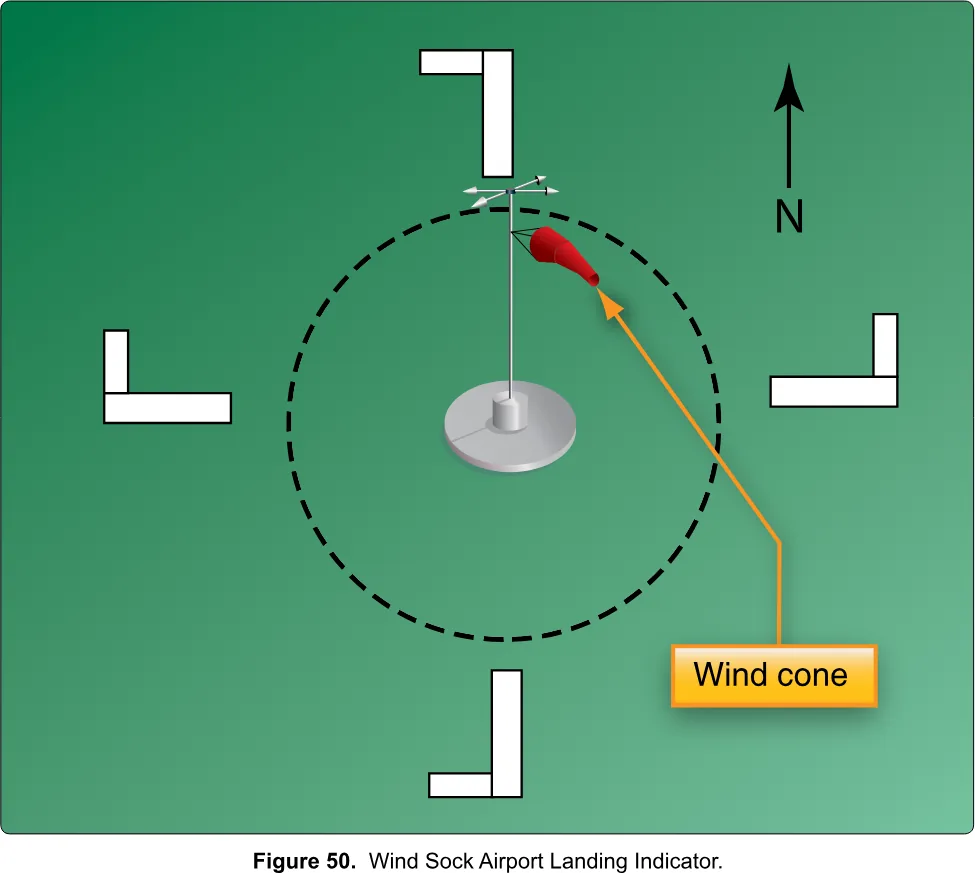
A wind cone is open at the end facing the wind, so its small end points downwind. In Figure 7-6 the small end points southeast, so the wind is blowing toward the southeast: a northwest wind. Pilots land into the wind, and the cone and pattern indicators together tell an arriving aircraft which runway and which way to turn.
FAA-CT-8080-2H, Fig. 50 · AIM, Ch. 4, Sec. 3Sources of airport information
The study guide lists four: aeronautical charts, the Chart Supplement, NOTAMs, and the ATIS. The sectional is the picture: location, elevation, longest runway, lighting, and frequencies. The Chart Supplement, formerly the Airport/Facility Directory, is the book, and the FAA calls it the most comprehensive source on a given airport. It comes in seven regional volumes, is revised every 56 days, is also available online, and has a legend that decodes every line. NOTAMs are time-critical, temporary information such as closures, construction, and changes in navigation aids, and you check them before every flight; the AC points to 1800wxbrief.com. The ATIS gives the airport’s current details while you listen.
FAA-G-8082-22, Ch. 11 · FAA Chart Users' Guide · AC 107-2A, para. 5.10.3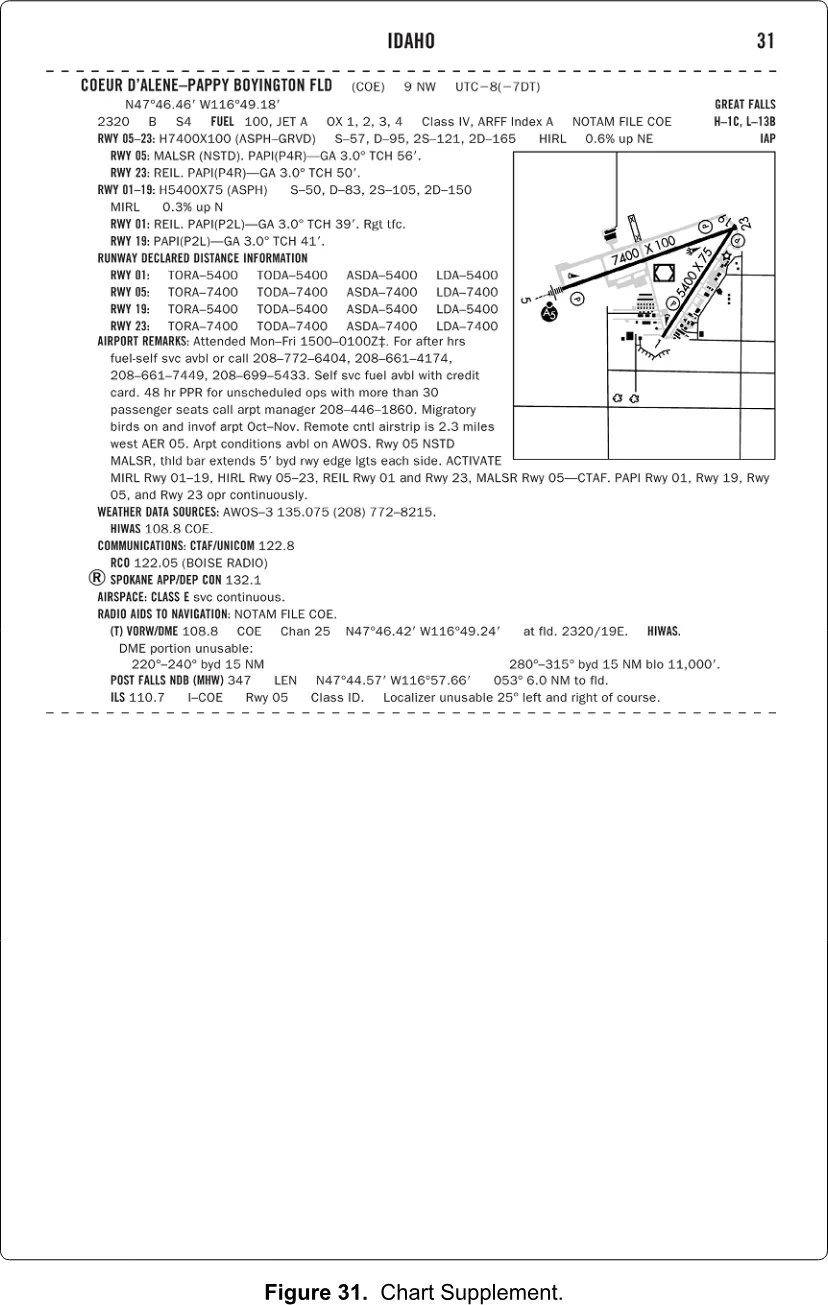
Figure 7-7 shows what the supplement holds: runways (5/23 is 7,400 by 100 feet), lighting and approach aids, communications (CTAF and UNICOM 122.8, plus a flight service outlet), the airspace line (Class E, continuous), weather sources (AWOS-3 on 135.075), and remarks: attended hours, fuel, and migratory birds on and near the airport in October and November.
FAA-CT-8080-2H, Fig. 31Lighting, wildlife, and security areas
The sectional gives a lighting code for runway edge lights, where a dash means none. It flags lighting limitations (on request, part-time, pilot-controlled) that only the Chart Supplement explains, and it marks a rotating or flashing beacon operating from dusk to dawn. At many small fields the pilot turns the lights on: the entry in Figure 7-7 says to activate them on the CTAF, which is why a dark field can light up within seconds at dusk. A seaplane base is shown with an anchor symbol and the same elevation, lighting, and length data.
FAA Chart Users' Guide, VFR Terms and Symbols · FAA-CT-8080-2H, Fig. 31Birds are a hazard to aircraft, and the Chart Supplement’s remarks are where you find where they gather. Give such fields extra room and do not disturb wildlife with your aircraft; strikes are reported under AC 150/5200-32, Reporting Wildlife Aircraft Strikes, the ACS’s reference. A Security Identification Display Area, or SIDA, is a part of an airport where airport-issued identification must be displayed. The FAA’s materials for this test give only the term, so recognition is what is asked.
FAA-S-ACS-10B, UA.V.B · FAA-G-8082-22, App. 1§ 7.3 — EMERGENCY PROCEDURES
Emergency procedures
Deviating from the rules in an emergency
In an in-flight emergency requiring immediate action, the remote PIC may deviate from any rule in Part 107 to the extent necessary to meet it. The AC defines such an emergency as an unexpected, unforeseen, serious occurrence requiring urgent, prompt action. The price is that if the FAA asks, the remote PIC must send a written report of the deviation. The study guide’s example is a battery fire: you may climb above 400 feet to maneuver to a safe landing, with a report only if asked. “To the extent necessary” is the limit. Break the altitude rule to get away from people, not to finish the shot.
14 CFR § 107.21 · AC 107-2A, para. 5.18 · FAA-G-8082-22, Ch. 5After an accident: § 107.9
A different report is mandatory. Within 10 calendar days, the remote PIC must report any operation involving serious injury or loss of consciousness, or damage to property other than the aircraft, unless the repair cost is $500 or less or the property’s fair market value is $500 or less. The AC’s examples: $200 of damage to property that would cost $600 to repair, and $200 of damage to property worth $600, are both below the line. Damage to your own aircraft never counts. Reports go to the FAA’s regional operations center, electronically or by phone, with your name and certificate number, the aircraft’s registration number, location, date and time, injuries, damage, and a description. The NTSB has its own rule, immediate notification when a person dies or is seriously injured or when an aircraft of 300 pounds or more is substantially damaged; a small UA is under 55 pounds, so for you only the first part can apply.
14 CFR § 107.9 · AC 107-2A, para. 4.4, 4.4.1, 4.4.2Briefing and planning
Before flight the remote PIC must make sure everyone directly participating is informed of the operating conditions, emergency procedures, contingency procedures, roles and responsibilities, and potential hazards, including any visual observer and any non-certificated person on the controls. The AC adds that contingencies should cover people or vehicles entering the operating area. Plan an alternate landing site, and agree how the crew will talk, for example by handheld radio on a non-aviation channel. The AC’s example is an EMS helicopter that needs your landing area while your battery is low.
14 CFR § 107.49(b) · AC 107-2A, para. 5.11.1, App. A, para. A.2.5.2, A.4.8.1Lost link, fly-aways, and the radio spectrum
A small UAS is controlled by radio, and when the link breaks the aircraft is on its own. Section 107.19(c) requires the remote PIC to ensure the aircraft poses no undue hazard to people, other aircraft, or property in the event of a loss of control for any reason, which makes this a planning duty. The AC says an automated aircraft that loses its link continues its mission or returns home to land, and that if the remote PIC loses sight of it the options are to land, hover, or return home, as the aircraft allows.
14 CFR § 107.19(c) · AC 107-2A, para. 5.2.3, 5.9A fly-away is a loss of control that does not end in a landing. The AC ties both problems to the spectrum. Most small UAS use the unlicensed 2.4 GHz and 5.8 GHz bands, shared with Wi-Fi, so dense housing and offices can interfere, and both bands are line of sight, so a barrier between you and the aircraft degrades the link. Control inputs that are delayed or out of sync mean stop flying and test the link. The FCC, not the FAA, regulates these transmissions: 900 MHz, 2.4 GHz, and 5.8 GHz can be used without a license, and any other frequency needs a user license. Many aircraft control on 5.8 GHz and send video on 2.4 GHz to reduce interference.
AC 107-2A, App. B, para. B.6 · App. C, Table C-1Return-to-home, and its traps
On most consumer aircraft, return-to-home flies the aircraft back to a recorded home point when the link drops. Whether yours hovers, lands, or returns is a setting, so read the manual.
This is practical reasoning built on § 107.19(c) and the AC’s preflight list, not FAA instruction, and your manual is the authority on what the aircraft does. The AC adds that geo-fencing has not been certificated by the FAA and air traffic does not decide authorizations on the strength of such equipment, so treat it as a convenience, not a guarantee.
AC 107-2A, para. 5.10.2, 5.11.1, 7.3.4 · 14 CFR § 107.19(c)Losing GPS
GPS often does more than navigate: it holds position in a hover and drives return-to-home. Without it the aircraft drifts in the wind and return-to-home has nothing to steer by, so you must be ready to fly manually, a skill you practice before you need it. That is a general consequence, not an FAA procedure, and your manual says which functions drop out. The first defense is on the ground: the preflight verifies that the aircraft has acquired GPS from the minimum number of satellites the manufacturer specifies.
AC 107-2A, para. 7.3.4Lithium batteries
The AC calls lithium-based batteries highly flammable and capable of ignition. Fires can follow a short circuit, improper charging, extreme heat, crash damage, mishandling, or a defect, and a fire in flight can cause loss of control. Follow the manufacturer’s recommendations. The preflight condition table flags a bulging casing (impending failure, abrupt power loss, possible explosion), falling flight time, and leakage.
AC 107-2A, App. B, para. B.5 · App. C, Table C-1The ACS splits the subject into transport, charging, use, and fire, and cites three FAA safety alerts: SAFO 09013, on fighting fires caused by lithium batteries in portable electronic devices; SAFO 10017, on transporting lithium batteries in cargo; and SAFO 15010, on spare lithium batteries in carry-on and checked baggage. The common thread in manufacturer guidance is to protect batteries from damage and short circuits in transit, charge with the right charger and watch the charge, and retire a battery that swells, leaks, or overheats. That is general practice rather than a quotation from the FAA texts, so confirm the details in your aircraft’s manual.
FAA-S-ACS-10B, UA.V.C · FAA-G-8082-22, App. 1Operations over people
Section 107.39 forbids flying over people unless they are directly participating, are under cover or in a stationary vehicle, or the flight meets one of four categories. Category 1 is an aircraft of 0.55 pounds or less including everything attached, with no exposed rotating parts that could lacerate skin. Categories 2 and 3 need an aircraft designed to limit injury (the energy of 11 and 25 foot-pounds), on an FAA-accepted declaration of compliance and labeled. Category 4 needs an airworthiness certificate.
14 CFR § 107.39 · 14 CFR § 107.110 · 14 CFR § 107.120 · 14 CFR § 107.130Your duty is to verify. Check the declaration at the FAA’s uasdoc.faa.gov site, check the label, and follow the remote pilot operating instructions; some aircraft have a flight-mode switch that sets the category, and a modification the instructions do not allow can end eligibility. Sustained flight over people means hovering above someone, flying back and forth over them, or circling over a person who is not involved. The regulations chapter covers the rules in full.
AC 107-2A, para. 8.3.5, 8.3.6.5, 8.3.6.7, 8.12, 8.13§ 7.4 — DECISION MAKING AND CREW RESOURCE MANAGEMENT
Aeronautical decision making and crew resource management
What decision making is
Aeronautical decision making, ADM, is a systematic approach to the mental process pilots use to choose the best course of action. It exists because experience alone does not produce judgment: the study guide says judgment can be taught, and pilots trained in ADM made 10 to 50 percent fewer judgment errors. The process has six steps: identify hazardous attitudes, learn to modify behavior, recognize and cope with stress, build risk assessment skills, use all resources, and evaluate your own ADM. Four principles anchor the risk side: accept no unnecessary risk, make risk decisions at the appropriate level, accept risk when the benefits outweigh the costs, and integrate risk management into planning at every level.
FAA-G-8082-22, Ch. 10The five hazardous attitudes
Attitude affects decisions as much as fitness does. The FAA’s technique is the same for each of the five: recognize the thought, label it hazardous, and state the antidote. Memorize the antidotes so they come to mind on their own.
| Anti-authority: “Don’t tell me.” | Follow the rules. They are usually right. | FAA-H-8083-25C, Fig. 2-4 |
|---|---|---|
| Impulsivity: “Do it quickly.” | Not so fast. Think first. | FAA-H-8083-25C, Fig. 2-4 |
| Invulnerability: “It won’t happen to me.” | It could happen to me. | FAA-H-8083-25C, Fig. 2-4 |
| Macho: “I can do it.” | Taking chances is foolish. | FAA-H-8083-25C, Fig. 2-4 |
| Resignation: “What’s the use?” | I’m not helpless. I can make a difference. | FAA-H-8083-25C, Fig. 2-4 |
The test gives a short scenario and the scenarios are written to tell the attitudes apart. Macho is about proving yourself: taking risks to impress others. Impulsivity is acting without thinking. Invulnerability is believing accidents happen to other people. Anti-authority treats rules as silly. Resignation is believing nothing you do matters, and can show up as going along with an unreasonable request to be agreeable.
FAA-H-8083-25C, Ch. 2Sample question 16 has a second lesson. The pressure comes from a manager, but § 107.19(b) makes the remote PIC the final authority on the operation, so you may say no.
14 CFR § 107.19(b)Hazard, risk, and the risk matrix
A hazard is a real or perceived condition, event, or circumstance you encounter. Risk is your assessment of its potential impact. Different pilots rate the same hazard differently (a nick in a propeller is low risk to a veteran and high to a novice), so write down your own minimums. The basic tool is the risk matrix, which sets likelihood against severity. The handbook scales likelihood as improbable, remote, occasional, probable and severity as negligible, marginal, critical, catastrophic. The AC’s scales run longer, to frequent and to no safety effect, and its risk levels are low, medium, high, and avoid.
FAA-G-8082-22, Ch. 10 · FAA-H-8083-25C, Ch. 2 · AC 107-2A, App. A, Fig. A-2The ringed cell is the handbook’s example: an occasional chance of running into instrument conditions, with a catastrophic result for a pilot who is not instrument rated, which makes it high. Mitigation moves a hazard on the grid, making it less likely, less severe, or both. The AC’s worksheet lists the hazard, cause, effect, likelihood, severity, risk, mitigation, and what you will do if it happens anyway. Its example is loss of control link over people: occasional, high, mitigated by a link check and a lost-link briefing. Then ask what risk remains, and whether your fix created a new hazard of its own, which the AC calls substitute risk.
FAA-H-8083-25C, Ch. 2 · AC 107-2A, App. A, para. A.4, A.4.10PAVE, 3P, and DECIDE
PAVE sorts the sources of risk, the 3P model loops through perceive, process, and perform, and DECIDE walks through a problem that has just appeared.
| PAVE (perceive hazards) | Pilot · Aircraft · enVironment · External pressures | FAA-G-8082-22, Ch. 10 |
|---|---|---|
| CARE (process hazards) | Consequences · Alternatives · Reality · External factors | FAA-G-8082-22, Ch. 10 |
| TEAM (perform: choose a control) | Transfer · Eliminate · Accept · Mitigate | FAA-G-8082-22, Ch. 10 |
| 3P | Perceive · Process · Perform | FAA-G-8082-22, Ch. 10 |
| DECIDE | Detect · Estimate · Choose · Identify · Do · Evaluate | FAA-H-8083-25C, Ch. 2 |
| 5 Ps (single-pilot resource check) | Plan · Plane · Pilot · Passengers · Programming | FAA-H-8083-25C, Ch. 2 |
In PAVE, the pilot box is the IMSAFE check in the physiology section below. The aircraft box asks whether this is the right aircraft and can it carry the load. The environment box covers weather, terrain, airspace, and TFRs. External pressures covers everything outside the flight that pushes you to finish. The FAA calls managing external pressure the single most important key to risk management because it can make you ignore every other box, and its tool is a set of personal standard operating procedures that release the pressure before it builds.
FAA-G-8082-22, Ch. 10 · AC 107-2A, App. A, para. A.4.8.2DECIDE has you detect the change, estimate the need to react (avoiding both overreaction and fixation), choose an outcome, identify solutions, do the action, and evaluate. In a fast emergency there is no time for the full loop, and experts take the first workable option their pattern recognition offers, which works only after training and is why rehearsal matters. The handbook also lists operational pitfalls: peer pressure, mindset, fixation on the original goal, falling behind the aircraft, flying outside the envelope, and neglecting flight planning, preflight inspection, and checklists. Staying out for one more battery to finish a survey is fixation; skipping the preflight because yesterday’s flight was perfect is neglect.
FAA-H-8083-25C, Ch. 2The accident chain
Most accidents are not one decision but a chain of poor choices, each of which was a chance to change the outcome.
Crew resource management
CRM is the effective use of all available resources: people, hardware, and information. The AC calls it a component of ADM and names the skills: situational awareness, allocating tasks, avoiding overload for yourself and others, and communicating clearly. The crew has more members than people expect. The remote PIC has final authority. A non-certificated person on the controls must be directly supervised, with the remote PIC able to take over at once. A visual observer is optional, but if used the PIC, the person on the controls, and the VO must communicate effectively at all times and coordinate scanning. Control passes between certificated pilots only by positive communication. Outside resources count too: a weather briefing, ATC, local pilots, landowners.
AC 107-2A, para. 5.3, 5.2.1.1, App. A, para. A.2.5.4 · 14 CFR § 107.12(a)(2) · 14 CFR § 107.33CRM runs through all three phases. Before flight it is the § 107.49(b) briefing, an agreed way to communicate, and assigned tasks. During flight it is the VO calling traffic and the PIC briefing the crew on changes, with constant reassessment of risk. After flight it is the debrief that captures lessons learned.
AC 107-2A, App. A, para. A.2.5.1, A.4.1, A.4.2Situational awareness, task saturation, and automation
Situational awareness is an accurate perception and understanding of everything that affects the flight before, during, and after it, not just where the aircraft is. Fatigue, stress, and overload fix attention on a single item. Workload management means planning, prioritizing, and sequencing. The first sign of overload is working harder and accomplishing less, and a task-saturated pilot misses input from other sources and decides on incomplete information. The remedy is to stop, think, slow down, and prioritize. A solo pilot has the least margin, and a visual observer lets you check displays while someone else watches the sky.
FAA-G-8082-22, Ch. 10 · AC 107-2A, para. 5.9.2Automation is a trap because it works: the handbook warns that displays capture attention for long periods. For a remote pilot the trap is the screen. First-person view does not satisfy the line-of-sight rule, and you cannot rely only on the aircraft’s lights or telemetry. The AC also names complacency and overconfidence as risks.
FAA-H-8083-25C, Ch. 2 · AC 107-2A, para. 5.9.1, 5.9.3, App. A, para. A.2.6Safety culture
A safety culture is what an organization does about risk before and after an incident.
UAG sample questions, Q17 · AC 107-2A, App. A, para. A.4.7, A.4.8.2§ 7.5 — PHYSIOLOGY
Physiology
The pilot is part of the aircraft
Part 107 uses a duty, not a medical certificate. No one may manipulate the controls or act as remote PIC, VO, or direct participant if they know, or have reason to know, of a condition that would interfere with safe operation. The AC lists lost dexterity, blurred vision, illness or medication that reduces awareness, debilitating pain, and hearing or speech impairment that blocks communication, which the PIC must work around, for example with sign language. The remote PIC answers for the whole crew.
14 CFR § 107.17 · AC 107-2A, para. 5.6, 5.16Alcohol
Section 107.27 imports § 91.17: no alcoholic drink in the preceding 8 hours, not under the influence of alcohol, a blood alcohol concentration below .04 percent, and no drug that affects mental or physical capability.
| Time since the last drink | at least 8 hours | AC 107-2A, para. 5.16 |
|---|---|---|
| Blood alcohol concentration | less than .04 percent | AC 107-2A, para. 5.16 |
| Under the influence | never, whatever the number | AC 107-2A, para. 5.16 |
| Drug affecting mental or physical capability | never | 14 CFR § 107.27 |
The 8 hours and the .04 are separate limits and both apply. The study guide advises being more conservative than the regulation: the body needs about 3 hours to clear one drink, and considerable amounts can remain for over 16 hours. A hangover is a continuing influence. Even small amounts impair judgment, reflexes, vision, and hearing, and alcohol interferes with the brain’s use of oxygen: the handbook equates an ounce to roughly 2,000 feet of added altitude.
14 CFR § 107.27 · FAA-G-8082-22, Ch. 9 · FAA-H-8083-25C, Ch. 17Drugs and medication
The regulations contain no list of banned medications, only the rule against any drug that affects your faculties contrary to safety, so the test asks for judgment. Virtually all medications, and supplements too, can have side effects. Antihistamines and decongestants cause drowsiness and cognitive deficits, and diphenhydramine (Benadryl) lingers. Wait at least 48 hours after the first dose of any new medication before flying. Aspirin, acetaminophen, and ibuprofen rarely matter at the proper dose; prescription analgesics such as codeine almost always do. Marijuana is illicit under federal law whatever a state allows.
FAA-G-8082-22, Ch. 9 · FAA-H-8083-25C, Ch. 17Fatigue and stress
Fatigue degrades attention, coordination, communication, and decisions. Acute fatigue is cured by rest and about 8 hours of sleep; chronic fatigue is not, and needs a physician; skill fatigue disrupts timing and narrows attention to the center of vision. If you are acutely fatigued, do not fly. It hides: the handbook calls fatigue one of the most insidious hazards because it may not show until serious errors occur, and a single pilot is his or her own quality control, so asked whether you are too tired, you tend to say no.
FAA-G-8082-22, Ch. 9 and Ch. 10 · FAA-H-8083-25C, Ch. 17Stress is the body’s response to physical and psychological demands, and some of it keeps you alert. Performance rises, peaks, and then falls off rapidly once stress exceeds your ability to cope. Acute stress is short term and triggers fight or flight. Chronic stress, from unrelenting pressure, drops performance sharply, and a pilot in that state should not exercise airman privileges. Regulations do not list stress as a grounding condition, but you must account for it: stop, think, and analyze in the moment, and manage time so deadlines do not become pressure.
FAA-G-8082-22, Ch. 9 and Ch. 10 · UAG sample questions, Q23Hyperventilation and hypoxia
Hyperventilation is breathing so fast and deep that you lose too much carbon dioxide. Anxiety triggers it, and a plausible trigger for you is the moment the aircraft stops responding. The symptoms are lightheadedness, tingling, visual impairment, hot and cold sensations, spasms, and, at worst, unconsciousness, and they resemble hypoxia. The cure is to breathe normally: slow down, talk aloud, or breathe into a bag.
FAA-G-8082-22, Ch. 9 · FAA-H-8083-25C, Ch. 17Hypoxia, too little oxygen, matters on the ground. The handbook says symptoms grow in severity above 10,000 feet, and night vision declines measurably above 4,000 feet of pressure altitude. Your limit is 400 feet above ground, not above sea level, so from a mountain launch site your body is at the launch elevation, whatever the aircraft’s height. Alcohol, fatigue, and smoking add to it; smoking at sea level can produce effects similar to 8,000 feet.
FAA-H-8083-25C, Ch. 17Dehydration and heat
Dehydration is a critical loss of water, caused by heat, wind, humidity, and diuretics such as coffee, tea, alcohol, and caffeinated soft drinks. The signs are headache, fatigue, cramps, sleepiness, and dizziness. Thirst arrives late, at about 2 percent of body weight lost, and a sip turns it off. Heatstroke is the failure to control body temperature, and it may show only at collapse, so drink at intervals whether thirsty or not. Remote pilots stand in the sun for hours, absorbed in a screen.
| Water to drink per 24 hours | 2 to 4 quarts (a guide only) | FAA-G-8082-22, Ch. 9 |
|---|---|---|
| Thirst appears at about | 2 percent of body weight lost | FAA-G-8082-22, Ch. 9 |
| Body absorbs water at | 1.2 to 1.5 quarts per hour | FAA-G-8082-22, Ch. 9 |
| Drink in severe heat | one quart per hour | FAA-G-8082-22, Ch. 9 |
| Drink in moderate heat | one pint per hour | FAA-G-8082-22, Ch. 9 |
Vision
Your eyes are the primary sensor. The line-of-sight rule requires you to see the aircraft with unaided vision, except for corrective lenses; binoculars may be used only momentarily.
AC 107-2A, para. 5.9, 5.9.1The effective scan moves side to side in steps, from the greatest distance inward, about 30 degrees wide per stop, no more than 2 to 3 seconds at each, overlapping the last by 10 degrees. The test calls this focusing on different segments of the sky for short intervals; the wrong answers are chasing peripheral movement and sweeping continuously.
FAA-G-8082-22, Ch. 9 · UAG sample questions, Q6Each eye has a blind spot where the optic nerve joins the retina. Two eyes cover it, but with one eye’s view blocked a target can vanish. In an empty sky or a haze layer the eyes relax to a focus of about 10 to 30 feet, called empty-field myopia: looking without seeing. The cure is to find something distant to focus on, however dim, and then scan. If you lose your aircraft, look at the horizon before you sweep.
FAA-H-8083-25C, Ch. 17Night vision and night illusions
Cones give color and detail in good light and fill the fovea at the center of vision. Rods work in dim light, see movement but not color, and ring the outside; once adapted they are about 10,000 times more sensitive. So at night the center is blind, and a dim object vanishes when you look straight at it.
The remedy is to look 5 to 10 degrees off center. An object held there fades after 2 to 3 seconds, so shift between off-center points. Dark adaptation takes about 30 minutes, and one bright light undoes it, so a preflight under a work light followed by launch is the standard trap. Neutral-density sunglasses before a night flight and dim light for reading controls help, while altitude, fatigue, drugs, alcohol, smoking, and skipped meals all cost night vision. Dawn and dusk, including civil twilight, are mesopic: the handbook calls them the most dangerous period for viewing, with acuity falling as the light does.
FAA-H-8083-25C, Ch. 17 UAG sample questions, Q43 · FAA Airman Testing Standards Branch, Changes to Testing (Apr. 5, 2021)Night illusions are what the eyes report when the usual cues are missing. A stationary light stared at in the dark seems to move, called autokinesis, so staring at your aircraft’s light against a black sky can make it seem to drift. A false horizon comes from sloping cloud, an obscured horizon, or patterns of ground lights. Ground lighting illusions include road lights mistaken for runway lights and a lone bright runway that looks closer than it is. Keep scanning and do not judge attitude or distance from one light. The AC adds that at night it is harder to see the aircraft’s location, attitude, altitude, and direction, and you cannot rely only on its light or telemetry to meet the line-of-sight rule.
FAA-H-8083-25C, Ch. 17 · AC 107-2A, para. 5.9.3Fitness for flight: IMSAFE
Hearing is how you talk to your crew, and a change in the sound of the propulsion system is on the FAA’s list of signs the aircraft is not fit. Motion sickness comes from conflicting signals to the brain, and the handbook advises against anti-motion-sickness drugs while flying because they cause drowsiness. The check to run before every flight is IMSAFE.
| I: Illness | Am I sick, or coming down with something? | FAA-G-8082-22, Ch. 10 |
|---|---|---|
| M: Medication | Anything, prescription or over the counter, that affects judgment or alertness? | FAA-G-8082-22, Ch. 10 |
| S: Stress | Under pressure from work, money, health, or family? | FAA-G-8082-22, Ch. 10 |
| A: Alcohol | Any within 8 hours? A hangover counts. | FAA-G-8082-22, Ch. 10 |
| F: Fatigue | Tired, or without a full night’s rest? | FAA-G-8082-22, Ch. 10 |
| E: Emotion (or Eating) | Emotionally upset? In AC 107-2A, the E asks whether you are nourished. | AC 107-2A, App. A |
Both versions of the last letter appear in FAA material: the study guide and handbook use Emotion, the AC’s worked example uses Eating. Ask both. The study guide’s practical version is to eat regular balanced meals, bring a snack and water, and get adequate sleep the night before.
FAA-G-8082-22, Ch. 9 and Ch. 10 · AC 107-2A, App. A, para. A.4.8.2 · FAA-H-8083-25C, Ch. 17§ 7.6 — MAINTENANCE AND INSPECTION
Maintenance and inspection
Condition for safe operation
Section 107.15 puts the aircraft’s fitness on you. No one may operate a small UAS that is not in a condition for safe operation, the remote PIC must check it before each flight, and no one may continue a flight when they know, or have reason to know, that it is no longer safe. The check is not delegated to the owner, the manufacturer, or a visual observer.
14 CFR § 107.15The manufacturer’s schedule, or your own
Maintenance, in the AC’s wide sense, includes scheduled and unscheduled overhaul, repair, inspection, modification, replacement, and software upgrades. Follow the manufacturer’s schedule, by flight hours, cycles, or calendar days, where one exists. Where none exists, the operator should establish a protocol: document each repair, modification, overhaul, or replacement along with the component’s time in service, and over time the history becomes a schedule. Unscheduled work is separate: a preflight may turn up something, or the manufacturer may require an unscheduled software update, and flight should not occur until it is done.
AC 107-2A, para. 7.2, 7.2.1, 7.2.1.1, 7.2.2For ordinary Part 107 operations there is no mechanic’s certificate requirement. If the manufacturer requires certain work to be done by itself or by named personnel, follow that; otherwise use people with expertise on that specific aircraft. If it cannot be restored to safe specification, replace it.
AC 107-2A, para. 7.2.3, 7.2.3.1The preflight inspection
Section 107.49 has two halves. The environment half is weather, airspace and flight restrictions, persons and property on the surface, and other ground hazards. The aircraft and crew half is the briefing, working control links, enough power for the intended operating time, and anything attached being secure, plus the category requirements if the flight is over people. The AC recommends 23 items, however good the manufacturer’s own list: the airframe, undercarriage, and control surfaces; legible registration markings; the propulsion system and propellers; a securely attached camera; control link and the minimum GPS satellites the manufacturer specifies; power in both aircraft and controller; correct control movement; compass calibration; spinning the propellers to check for imbalance; a low-altitude recheck of controls and stability; and the anti-collision light for twilight or night. Part 43 appendix D, the manned-aircraft checklist, is an alternative structure (airframe, then controls, then batteries) but misses data links, so you must add them.
14 CFR § 107.49 · AC 107-2A, para. 7.3, 7.3.3, 7.3.4The AC’s Table C-1 lists conditions that may mean the aircraft is not fit to fly.
| Structural or skin cracking, delamination | hidden damage may compromise structural integrity | AC 107-2A, Table C-1 |
|---|---|---|
| Liquid or gel leakage; fuel smell | a source of fire and extreme heat | AC 107-2A, Table C-1 |
| Electrical burning smell; soot or sparking | electrical malfunction, risk of fire | AC 107-2A, Table C-1 |
| Noticeable change in propulsion sound | damage or reduced performance in motors or propellers | AC 107-2A, Table C-1 |
| Control inputs delayed or out of sync | discontinue flight; test the link; risk of collision or fly-away | AC 107-2A, Table C-1 |
| Bulging battery casing | impending failure, abrupt power loss, possible explosion | AC 107-2A, Table C-1 |
| Falling flight time | battery nearing the end of its life or damaged | AC 107-2A, Table C-1 |
| Loose or missing hardware | structural failure or dropped parts; secure or replace | AC 107-2A, Table C-1 |
Batteries, firmware, records, and grounding
Mitigating mechanical failure means covering every element. For power, ensure there is enough to land normally, using the manufacturer’s consumption tables or a low-power alert, and check battery levels in both the aircraft and the controller. For the link, verify connectivity and GPS before launch. For software, a manufacturer may require an unscheduled update, so check before the job, not in the field, and remember that a modification the instructions do not allow can end an over-people aircraft’s eligibility. Keep a log of inspections, maintenance, repairs, and alterations for every component, including the controller, launch gear, link equipment, and payload; outside Category 4 the AC presents this as beneficial rather than required. Carry your remote pilot certificate, identification, and the aircraft’s registration, and any waiver, ready for inspection.
AC 107-2A, para. 5.11.1, 7.2, 7.3.5, 8.3.6.5 · 14 CFR § 107.49(f)The grounding standard is knowledge. Section 107.15(b) says stop when you know or have reason to know the aircraft is no longer in a condition for safe operation, and the study guide says irregularities found in a preflight must be corrected before flight. If you have to ask whether something matters, you have your answer. Ground it, find the cause, and write it down.
14 CFR § 107.15(b) · FAA-G-8082-22, Ch. 5§ 7.7 — NIGHT OPERATIONS
Night operations, briefly
Night runs from the end of evening civil twilight to the beginning of morning civil twilight. In the continental United States civil twilight is the 30 minutes after official sunset and the 30 minutes before official sunrise; Alaska uses a different definition. Twilight is not night, but it carries the lighting requirement.
| Civil twilight, evening | official sunset to 30 minutes after | 14 CFR § 107.29(c) |
|---|---|---|
| Civil twilight, morning | 30 minutes before official sunrise to sunrise | 14 CFR § 107.29(c) |
| Anti-collision light, twilight and night | visible for at least 3 statute miles | 14 CFR § 107.29(a), (b) |
| Pilot training for night | knowledge test or recurrent training after April 6, 2021 | 14 CFR § 107.29(a)(1) |
| Eye adaptation to darkness | about 30 minutes | FAA-H-8083-25C, Ch. 17 |
At night, and in twilight, the aircraft must have lighted anti-collision lighting visible for at least 3 statute miles with a flash rate sufficient to avoid a collision. For night, the remote PIC must also have completed an initial knowledge test or training after April 6, 2021 that covers night operations; the test you are studying for counts. The light may be dimmed but never extinguished: the AC’s example is a strobe so near the pilot that it costs the pilot the aircraft’s attitude. Daytime flight needs no lights.
14 CFR § 107.29 · AC 107-2A, para. 5.7, 5.7.2.2 · FAA Airman Testing Standards Branch, Changes to Testing (Apr. 5, 2021)The rest is the earlier parts applied. Check the light and whether it drains enough power to shorten the flight; consider unlit towers and whether other aircraft could see the light at 3 miles; restrict the operating area to where you can still see the aircraft; and plan for the 30 minute adaptation, off-center viewing, and autokinesis.
AC 107-2A, para. 5.9.3, 5.11.1, App. A, para. A.4(a)(6)The civil twilight and night lesson turns the same rules into a dial: set a date and a latitude and watch twilight move.
You should now be able to
- Explain why a remote pilot listens to the CTAF, and say which frequency is the CTAF on a sectional chart
- Read a position report such as midfield left downwind runway 13 and say which side of the runway the aircraft is on
- Name the legs of the traffic pattern, say where a UA at 400 feet can meet it, and pick the right airport information source
- State what § 107.21, § 107.9, and § 107.49(b) require after or before an emergency, and who must be told what
- Describe what lost link, a fly-away, GPS loss, and a lithium battery fire demand of the plan before launch
- Name each of the five hazardous attitudes with its antidote, and use PAVE, IMSAFE, DECIDE, and the risk matrix
- Apply the alcohol, medication, fatigue, and vision rules, including the 30-minute dark adaptation
- Build a maintenance schedule when none exists, and run a preflight that grounds an unfit aircraft
- State the lighting and training conditions for flying at night and during civil twilight