Deep dive — weather
Density altitude
Three sliders, one answer: how field elevation, pressure, and temperature combine into the altitude the air thinks it is at, and what that does to a small aircraft.
The altitude the air thinks it is at
Density altitude is the altitude at which the standard atmosphere has the same air density as the air you are actually standing in. Put plainly: it is the altitude the air thinks it is at. On a standard day it matches the elevation of the field. On a hot day, or a low-pressure day, the air is thinner than the sign at the launch site says, and the air behaves as if you were higher up. FAA-H-8083-25C, Ch. 11 (Density Altitude)
A 2 kg aircraft cares because everything it does, it does by pushing on air. A propeller is a small rotating wing. Each blade bites into the air and throws it backward, and the reaction is thrust. In thin air each bite is smaller, so the same motor speed makes less thrust. The flight controller asks for more RPM to hold the same hover, the motors draw more current, and the battery empties sooner. FAA-H-8083-25C, Ch. 11 · FAA UAG Sample Questions, Q4
The consequences for a small unmanned aircraft are all versions of one thing: less margin. A shorter flight for the same battery. A slower climb. Less reserve of power to fight a gust or recover from a downdraft. Batteries make it worse in heat, because the same hot afternoon that thins the air also warms the pack, and the advisory circular names extreme heat as one way a lithium battery gets into trouble. AC 107-2A, App. B.5
The three ingredients
Three things set the density of air: how much pressure is pushing on it, how warm it is, and how much water vapor it holds. The test is mostly about the first two. FAA-H-8083-25C, Ch. 11 (Density Altitude)
Pressure altitude
Pressure altitude is the height above the standard datum plane, the level where pressure would be 29.92 inches of mercury. It is the number your altimeter shows when you set it to 29.92. FAA-H-8083-25C, Ch. 11 (Pressure Altitude) You get it from two things you already know: the field elevation and the altimeter setting in the weather report. Pressure falls about an inch for every 1,000 feet you climb, so each inch of mercury your local pressure sits below 29.92 adds about 1,000 feet to the pressure altitude, and each inch above subtracts about 1,000. FAA-H-8083-25C, Ch. 12 (Measurement of Atmospheric Pressure)
Temperature
Warm air is less dense than cold air, so a given pressure altitude is thinner on a warm day. To say how warm is “too warm”, you need a reference. The standard atmosphere supplies one: 15 degrees Celsius at sea level, falling about 2 degrees for every 1,000 feet of height. The lab labels that reference temperature ISA. FAA-H-8083-25C, Ch. 12 · FAA-H-8083-28B, Ch. 4.4 Subtract the standard temperature at your pressure altitude from the real temperature and you get the deviation: how many degrees warmer or colder than standard it is. Then comes the rule of thumb: density altitude rises about 120 feet for every degree Celsius above standard, and falls by the same for every degree below.
Humidity
Moist air is therefore less dense than dry air, which pushes density altitude up a little. The handbook says humidity alone is usually not considered an essential factor, but it does contribute, and that there is no rule of thumb or chart to compute it: you simply expect a further drop in performance on a muggy day. FAA-H-8083-25C, Ch. 11 (Effects of Humidity on Density) That is why the lab has no humidity slider, and why its answer is always slightly optimistic on a humid day.
| Standard sea-level pressure | 29.92 inches of mercury | FAA-H-8083-25C, Ch. 12 |
|---|---|---|
| Standard sea-level temperature | 15 °C (59 °F) | FAA-H-8083-25C, Ch. 12 |
| Pressure change with height | about 1 inch per 1,000 ft | FAA-H-8083-25C, Ch. 12 |
| Temperature change with height | about 2 °C colder per 1,000 ft | FAA-H-8083-25C, Ch. 12 |
| Density altitude per degree above standard | about 120 ft per °C (rule of thumb) | Field rule; the chart is the authority |
The arithmetic, worked twice
Four steps, always in the same order. Find the pressure altitude. Work out the standard temperature at that pressure altitude. Take the difference from the real temperature. Multiply by 120 and add the result to the pressure altitude.
First, a cool morning at a sea-level field. Elevation 0 feet, altimeter 29.92, outside air 5 degrees Celsius. Pressure altitude is 0 feet. Standard temperature at 0 is 15, so today is 10 degrees below standard. Ten degrees at 120 feet each is 1,200 feet, subtracted. Density altitude is about minus 1,200 feet: the air is denser than the standard air at sea level, and the aircraft performs as if it were 1,200 feet below it. Good news for thrust, and good for the battery too, as long as the pack is warm enough to deliver its current.
Second, a hot afternoon at a field 5,000 feet above sea level. Altimeter 29.92, outside air 35 degrees Celsius. Pressure altitude is 5,000 feet. Standard temperature there is 15 minus 10, which is 5 degrees. Today is 30 degrees above standard. Thirty degrees at 120 feet each is 3,600 feet, added. Density altitude is 5,000 plus 3,600, or 8,600 feet. Your aircraft is parked at 5,000 feet and flying like it is at 8,600.
If the altimeter reads 29.62, a low-pressure day, the pressure altitude is 300 feet higher and the answer climbs to about 9,000.
Reading the FAA chart
On the test you will not be asked to remember 120. You are given the chart, Figure 8 in the testing supplement, and it is shown under the lab below so you can see it next to the sliders. FAA-CT-8080-2H, Figure 8 It has two parts. The table on the right turns an altimeter setting into a pressure altitude conversion factor; add it, sign included, to the field elevation. The graph on the left does the rest: find the outside air temperature along the bottom (the scale carries both Celsius and Fahrenheit, so check which you are reading), go straight up to the sloping line for your pressure altitude, then straight across to the left edge and read the density altitude in thousands of feet. FAA-H-8083-25C, Ch. 11 (Density Altitude Charts)
The handbook works one example on its own copy: a field at 5,883 feet, 70 degrees Fahrenheit, altimeter 30.10. The table gives minus 165, so pressure altitude is 5,718 feet; the chart gives about 7,700. The rule of thumb gives about 7,800 for the same inputs, close enough to confirm you did not misread a line. FAA-H-8083-25C, Ch. 11 (Density Altitude Charts)
Three experiments in the lab
The lab below has three sliders: field elevation, altimeter setting, and temperature. A gauge puts field elevation, pressure altitude and density altitude on one scale, and a sentence under the readout escalates as the air thins. Try these in order.
First, temperature alone. Set elevation to 0 and altimeter to 29.92, then drag temperature from minus 20 up to 45. Density altitude swings from about minus 4,200 to about 3,600 feet, nearly 8,000 feet of change, with the airfield sitting still. Watch the orange bar: it sits on top of the other two rows only at 15 degrees, the standard temperature at sea level.
Second, pressure alone. Set elevation to 5,000 and temperature to 5, the standard temperature there, so density altitude equals field elevation at 29.92. Now drag the altimeter from 28.50 to 31.00. Density altitude runs from roughly 6,800 feet down to 3,700. A weather system moving through changes the thickness of the air by about 3,000 feet without any change in the thermometer.
Third, the afternoon. Keep elevation at 5,000, altimeter at 29.92, and set temperature to 35 to reproduce the 8,600. Now drag it down to 15, which is a cool morning at that field. Density altitude falls to about 6,200, and by 10 degrees the sentence changes to the next tier down. Two to three thousand feet of air thickness, bought by flying early.
What to do about it
The practical rules follow from the mechanism. They are the sort of thing a good operator does without being told, and the advisory circular says the same of loading: at high elevation, in heat, or in humid air, you may need to reduce weight before flight. AC 107-2A, App. B.2.1.1
- Fly a lighter aircraft. Leave off the payload you do not need; less weight means less thrust to hold it up.
- Plan shorter flights. The same battery gives less time in thin air, so shorten the route rather than trust the label.
- Bring a bigger reserve. Land with more charge than you would at sea level on a cool day.
- Avoid midday. Temperature peaks mid-afternoon; early morning and evening flights see thicker air and cooler packs.
- Watch hover current. If your app shows current or battery percent in the first minute, a high number is the air telling you its density altitude.
- Let the weather tell you. ASOS and AWOS broadcasts include density altitude once it exceeds the field elevation by more than 1,000 feet, and ATIS says to check density altitude when appropriate. FAA-H-8083-28B, Ch. 3.4.2.24
Remember also that the 400-foot ceiling is above ground level, while density altitude depends on how high the ground itself is. A launch site at 8,000 feet has 8,000-foot air at zero AGL.
Where this goes next
Density altitude is a weather number that behaves like a weight number: it takes margin away that you would otherwise spend on payload. Read Loading and performance for how weight, balance and power limits trade against it, and Weather for the pressure, temperature and moisture behind the numbers, including where to get the altimeter and temperature readings you need. Once you have moved the sliders enough to predict the readout before you see it, you have the part the test asks about.
Hot, high, and humid: how thin is the air today?
- Pressure altitude
- 1,500 ft
- ISA at that altitude
- 12 °C
- Deviation
- +13 °C
- Density altitude
- 3,060 ft
Noticeably thinner air. Propellers bite less, motors run harder, and battery reserve shrinks; expect a sluggish climb and less margin in wind. FAA-H-8083-25C, Ch. 11; FAA-CT-8080-2H Fig. 8
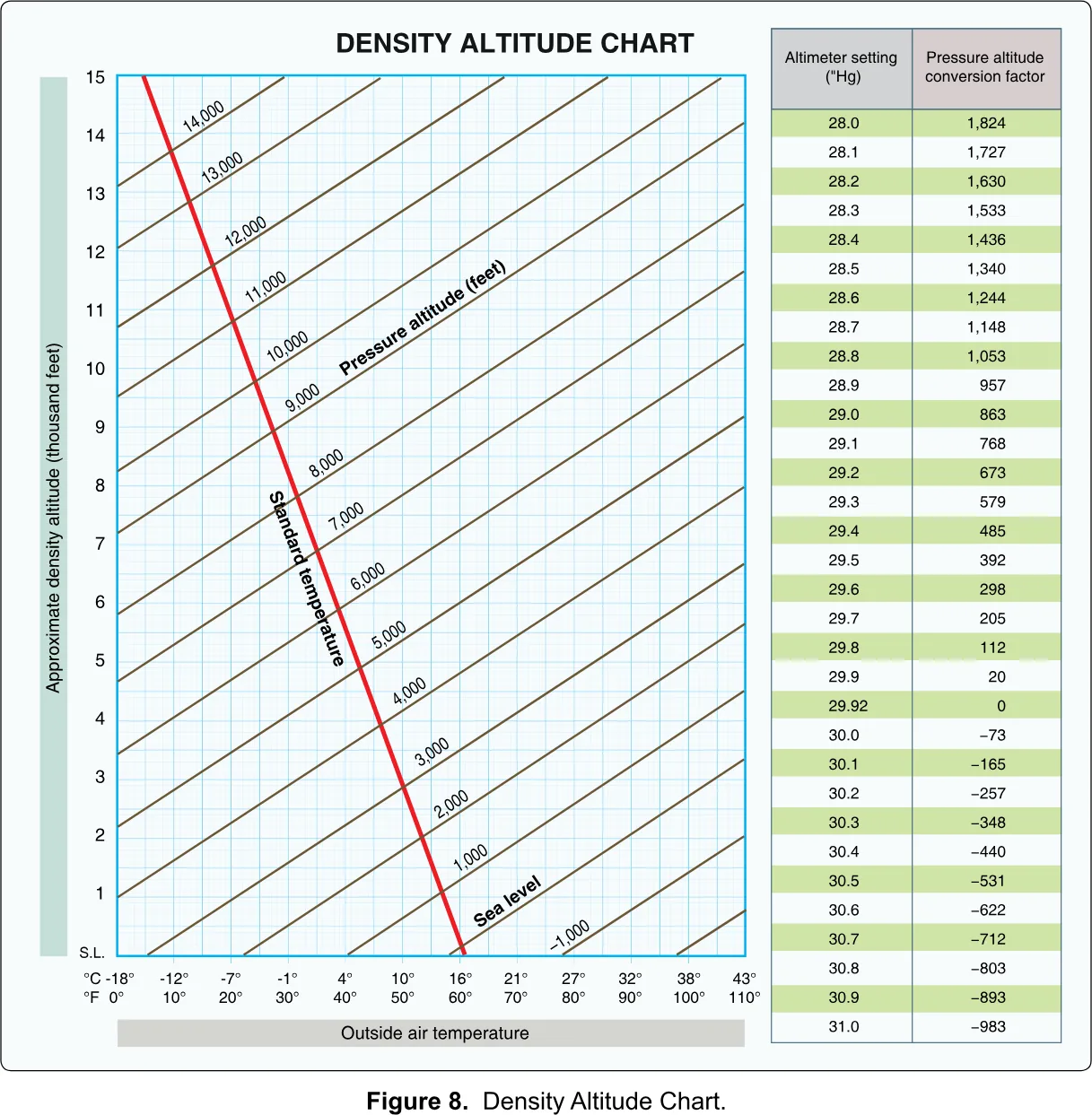
The arithmetic is the FAA's rule of thumb: 1,000 ft of pressure altitude per inch of mercury, ISA cooling 2 °C per 1,000 ft, and about 120 ft of density altitude for every degree above standard. The chart in the testing supplement does the same thing graphically.